Ingredients
/
Vegetables
/
Sauerkraut
 Year-round
Season
Year-round
Ruled by
♇ Pluto
Calories
9 kcal
Protein
1.1 g
MW reference
1
Sauerkraut
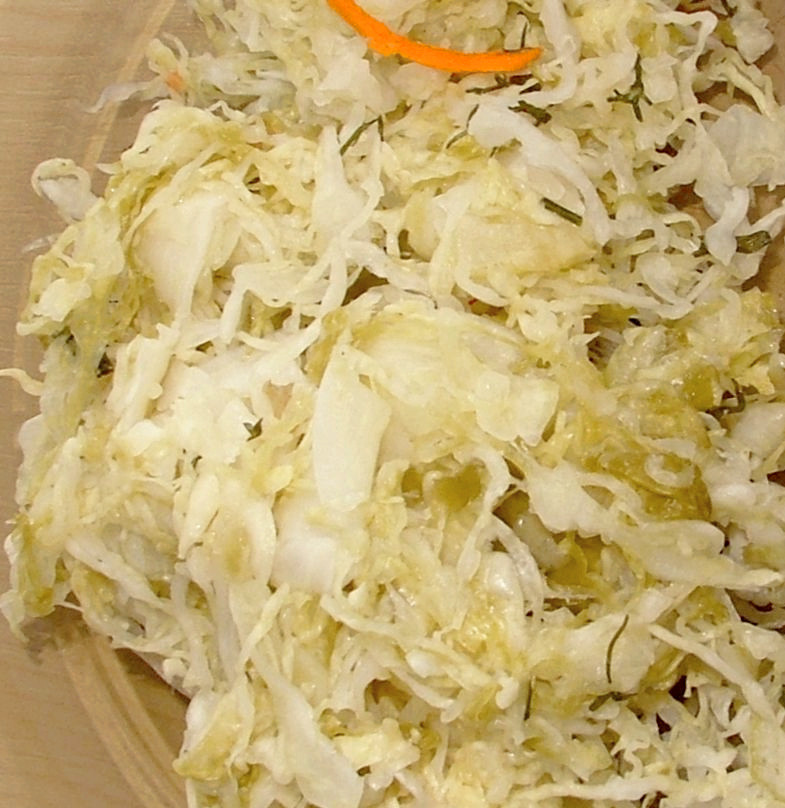
Sauerkraut is a year-round staple, offering consistent flavor and nutrition through the ancient art of fermentation. Originally a winter survival food, it now serves as a convenient, tangibly sour accompaniment to many dishes. It is a significant source of probiotics, vitamin C, and vitamin K2, supporting digestive and immune health.
Nutrition facts
Per 100 g
Energy9 kcal / 36 kJ
Protein1.1 g
Carbs1.1 g
— of which sugars1.1 g
Salt590 mg Na
Vitamin C10.0 mg
Iron1.20 mg
Figures are estimates per 100 g from reference data and may differ from the product you use. Always check the packaging for accurate nutrition and allergen information. Not a substitute for professional dietary advice.
Reference data McCance & Widdowson 2021
Sauerkraut · 13-336 · DR
10 samples, 3 brands. Bottled and canned, drained
Energy & Proximates
Energy9.00kcal
Energy36.00kJ
Water91.00g
Protein1.10g
Fat—g
Carbohydrates1.10g
of which sugars1.10g
of which starch—g
Fibre (AOAC)—g
Fibre (NSP)2.20g
Alcohol—g
Fat Breakdown
Total fat—g
Saturated—g
Monounsaturated—g
Polyunsaturated—g
Trans—g
Omega-3—g
Omega-6—g
Cholesterol—mg
Minerals
Sodium590.00mg
Potassium180.00mg
Calcium50.00mg
Magnesium10.00mg
Phosphorus23.00mg
Iron1.200mg
Copper0.050mg
Zinc0.300mg
Selenium—µg
Iodine1.00µg
Vitamins
Vitamin A3.00µg
Vitamin D—µg
Vitamin E—mg
Vitamin C10.00mg
Thiamin (B1)0.040mg
Riboflavin (B2)0.010mg
Niacin (B3)0.200mg
Vitamin B60.150mg
Vitamin B12—µg
Folate16.00µg
Recipes using Sauerkraut
More from Vegetables